
7 Ways Phase Shifts Can Kill Your Goosebumps.
- Arved Deecke

- 7. aug. 2015
- 7 min læsning

When buying speakers there are a couple of parameters that are rather intuitive for us to grasp. Distortion is very audible, and we all know what that sounds like and why we don't want it. A flat response is clearly desirable, and for some reason we have at some point decided that bass should go down to 20Hz although very few musical instruments actually do. Those who have thought about this some more are also aware of the beautiful spacious sensation that great imaging can produce.
But there is a problem with speakers that even many advanced audiophiles are unaware of which can take an otherwise great system and make it a lot of trouble to own. This problem is phase congruency.

In wave theory the phase is measured in a rotational angle usually in radians and describes where in its cycle the wave is at. A zero phase means the pressure is zero, but on the rise, a 90 degree (or pi/2) phase means the pressure is at its maximum, at 180 degrees (or pi), the pressure reaches zero again but is on the fall while at 270 degrees (3pi / 2) the pressure is at its lowest.
If you imagine two point source loudspeakers which are 180 degrees out of phase and in the same location, playing the exact same tone, the result would, in theory be silence as both cancel each other out. Many noise cancellation systems use this effect by producing an opposite wave to the one produced in a noisy environment thus creating a near constant zero pressure at the listener's ear
Not all phase congruency issues are as apparent as noise cancellation. A less than 180 degree shift, leads to a narrow band of cancellations and superimpositions that can make the listening experience rather unfulfilling.
If you find yourself trying many different listening positions and hunting that very special sweet spot, then you may well have a phase congruency issue. Other indicators are a blurred stereo image and coloration of sound.
In loudspeaker design, there are 3 areas where this can be a problem.
1. Phase shift from the cross over filter
Many if not most loudspeakers on the market today have such phase shifts due to the fact that higher order electronic crossovers are used to divide the frequencies to the different drivers and the result is that around the crossover point, the woofer might actually be going inwards, while the mid is pushing out.
Some advanced designs compensate for this by employing rather complex first order cross-overs, others yet use electronic delay to compensate. The problem with all these compensations is that they are optimized only around one specific frequency and while the crossover point is called a point, in reality it actually spans one or more octaves.
Full range speaker systems of course do not have this problem, making them a rather desirable solution when trying to offer a high-end audio product at a good price.
2. Phase delay from differing acoustic centers of each driver
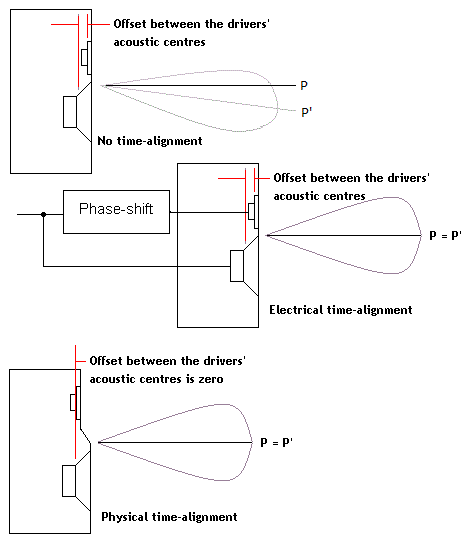
Each loudspeaker has an acoustic center along its axis where the sound seems to originate from. Depending on the excursion of the driver, that acoustic center depends on several factors including the excursion while woofers have an acoustic center that is placed further back than mid range drivers and tweeters.
In any design other than one using a full range driver, this will need to be corrected for, but in many instances, even with very high end loudspeakers it is not. One way is, of course, an electronic delay at a crossover level for the higher frequencies.
A purely acoustical alternative seen in some designs is to slant the loudspeaker cabinet and move the mid range drivers and tweeters a little farther back in the cabinet to align the acoustic centers as shown in the picture. This tends to be a rather robust solution that works over a wide frequency range.
3. Phase delay from the so-called baffle step.

Below a frequency that corresponds to twice the wavelength of the width of the cabinet, the pressure wave from the driver stops being unidirectional and starts being reflected forward into what is called a half space. This has several undesirable effects. One is that since the sound energy now is radiating forward and not all around, the loudness reaching the listener above the baffle step frequency increases by a factor of two (6dB). This means that wider cabinets that don’t provide acoustical means to compensate for the baffle step require equalization or baffle step compensation. If a given speaker cabinet is 30cm wide then a 6dB increase will occur somewhere around 1130 Hz. The compensation, unless done in the digital realm can again produce a phase shift that will lead to audible degradation.
The real problem about a wide baffle, however, is that the diffracted wave front reaches the listener with a phase delay compared to the primary wave front leading to a blurred stereo image and narrow cancelations and superimpositions.
Full range systems suffer from the same phenomena, and care must be taken that the cabinet be no wider than necessary This may prove to result in some trade off for bass extension that would fair better with a larger driver, but certain enclosures like quarter wave enclosures can be tuned rather aggressively without coloration of bass and provide sufficiently low bass for most real world musical instruments.

A rather narrow front baffle or a pyramid design, as shown, are good ways to remedy baffle step diffraction and offer good results in many high end speakers. Many manufacturers that do not use a full range approach also have the woofer facing to the side which is another rather good solution when it comes to minimizing baffle step phase issues.
4. Phase shifts from membrane break up.

This consideration is really only an issue with full range systems that employ rather large drivers to get to very low bass levels. A driver membrane depending on its size and material will move back and forth up to certain frequencies, and then break up into more complex modes of oscillation. At this point one part of the membrane might be moving forward while the other moves back leading to cancellations and super-impositions, distortion and again a blurred stereo image. Incidentally, guitar amp manufacturers take great pride in membrane break up as it provides the sought after signature sound to their product, but the effect is always a problem in accurate reproduction of sound.
Most loudspeakers that employ several drivers will not likely show membrane break up as the drivers will not operate in that frequency range. But anyone who is interested in a full range system should look out for design features that prevent membrane break up. If you can live with normal listening room loudness and electronic techno music with deliberately low bass is not your thing, a full range system in a well designed enclosure should not need to employ a driver larger than 3 inches and therefore show no membrane break up in the audio range. This will also remedy any baffle step issues as mentioned before.
Anything bigger and driver manufacturers include a feature called a whizzer cone, which can remedy break up to some degree.
5. Phase shifts from resonant ports

A bass reflex design has the advantage of extending bass below the capabilities of the driver using an effect called Helmholtz resonance. The problem here is that it emits the entire frequency spectrum of the drivers in the enclosure. If the woofers are not isolated from the rest of the drivers in a multi driver system, then sound will originate from different places and reach the ear in different phase.
Transmission lines and particularly quarter wave designs that are carefully dampened can eliminate all output above 200Hz from the port with a separation of 20dB ad will not have such problems unless there is a design issue at hand.
6. Phase shifts from waves sent to the back of the driver and reflected back out through the membrane from the back wall.

A loudspeaker driver will emit as much sound energy to the back as it will to the front. The main purpose of any cabinet is to absorb this sound pressure and contain it. While cabinet walls can be sufficiently isolated to perform this task well, the weak point is always the driver membrane itself, which is thin and very permeable and thus predisposed to sound reflecting back through it.
A possible remedy here is the use of dampening material on the back wall that absorbs such undesirable reflections, but many very high end loudspeakers use curved sidewalls to eliminate a reflective surface that is parallel to the membrane all together.
Curved walls, of course are a manufacturing challenge, and straight boxes are easier to build, but a product that employees such strategy demonstrates that it has been optimized for phase congruency.
7. Phase shifts due to the same sound originating from different locations.
Any loudspeaker that employes more than one driver that are not in a coaxial position will originate the same sound from two different points around the crossover frequencies. If the two drivers are sufficiently far appart, acoustic lobing will occur leading to an uneven distribution of sound throughout the listening space. Acoustic lobing will also lead to coloration of the sound and narrow bands of cancellations and super-positions called comb filters.
Beyond that however, in almost all listening positions that don't happen to form an isoceles triangle with both drivers, the same sound will travel a different distance to the listeners ear, depending on what driver it originated from. This again is a source of phase shifts and a blurred stereo image and there is no good way to avoid that in non coaxial multi driver systems.
Full Range Loudspeakers do not struggle with this problem.
Conclusion
The outcome of a phase congruent system is probably the most surprising improvement to sound that we audiophiles can experience. A system that is designed with this aspect in mind can bring a clarity and presence to the music that other systems simply will not have. While hunting for phase congruency is a daunting task especially with the much more complex multi driver systems, you will hear it once you have accomplished the goal. Many of our customers describe their experience with a simple and enjoyable bodily response: Goosebumps.
Arved Deecke is founder of the Danish / Mexican Loudspeaker company KVART & BØLGE that makes audiophile quarter wave loudspeakers and sound systems at a price anyone can afford. In his free time he blogs about all things related to sound, music and audio.


Kommentarer